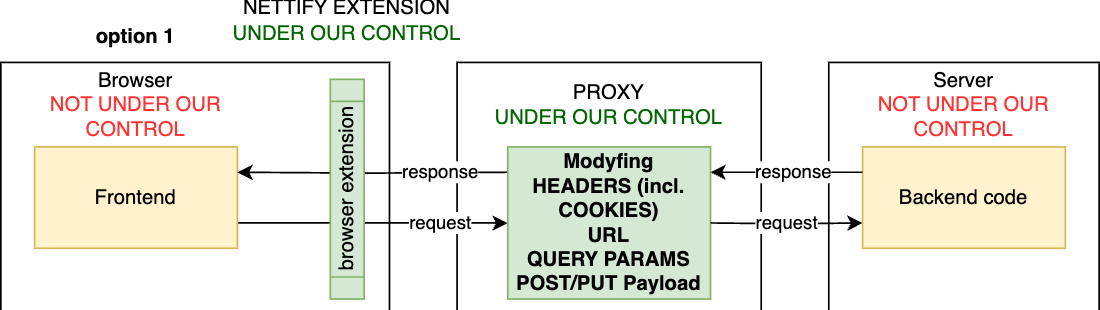
 When working with APIs, dealing with raw JSON for input and output can be cumbersome, especially when there’s a convenient UI designed specifically for that API. However, the UI doesn’t always keep up with changes in the service, and sometimes it’s useful to emulate changes in the service along with the UI to finalize decisions on what and how to modify.
Such a solution could allow you to replace actual API responses with tailored fake data, eliminating the need for altering real data or making code changes. It would accelerate slow requests by recording and replaying them, significantly reducing wait times for UI tweaks. Developers could simulate edge cases, such as handling 4XX or 5XX status codes or testing long strings, by modifying response bodies, status codes, or headers, or add a debug/verbose mode automatically to all calls to an API. Additionally, it would enable frontend development against unimplemented APIs by mocking responses, facilitating progress even when backend endpoints are incomplete. For integration with third-party platforms that only function on production domains, such a solution could reroute requests, allowing safe testing on production without risk. Furthermore, it would support debugging by adding artificial delays and simulating network errors, ensuring robust handling of edge cases. In essence, mocking servers on production in your browser would streamline development, enhance testing, and ensure a more resilient application.
As the “victim,” I chose the SAP Commerce demo store (to whose code I don’t have access to), specifically its search functionality. The goal was to inject my custom code between its backend and frontend, and as a demonstration of capabilities, automatically apply certain facets for specific queries. As a result, for the query “cheap cameras,” I will actually see cheap cameras and not tripods, for example.
